Flashcards have been widely used in early childhood education but contrary to what you might think, this tool is not only useful for children. As a learning resource, Flashcards are the key to strengthening your memory and absorbing information easily.
One of its main benefits, the development of an active memory, can help you achieve important academic goals regardless of your level of study. But how does this process work? Keep reading to find out how this great learning technique can improve your memory.
What is Active Memory
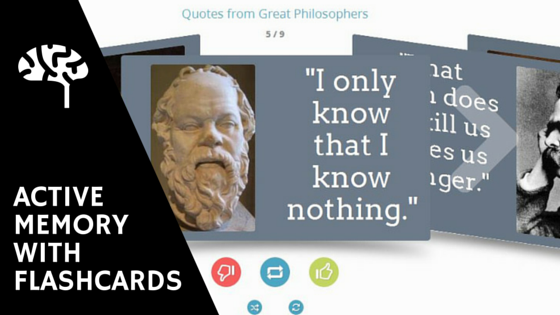
When using Flashcards, we force our brain to absorb and retain the information found at the back of the cards following the tip that is provided to us on the front of the cards. This active process exercises our memory which in turn stimulates memorization. It is a method that is much more effective than passively studying material.
Short and Long Term Benefits
Active recovery of information not only improves our short-term memory (e.g. when sitting an exam) but it also provides us with long-term benefits. According to experts, the most effective way to internalise and retain knowledge long-term is to combine the active recovery of information with space repetition.
Ideally, Flashcards should be reviewed in periodic intervals. Start reviewing your Flashcards daily, then weekly, then monthly and so on. This way, you will end up automatically absorbing all the necessary knowledge and strengthening your active memory.
This method is unknowingly used when learning so it makes complete sense to apply this natural process to our academic study as well.
When we start learning something new, we focus on learning through high levels of repetition. With time, we incorporate this process into our routine until we automatically start executing it. Using Flashcards pushes this process even further, making our memorization an active process.
Creating Flashcards
Cutting paper to create a Flashcard deck? That is a thing of the past! Creating Flashcards has become an intuitive and quick process thanks to GoConqr’s online tools. Do you want to see an example?
Flashcards Usage
As we mentioned at the beginning of this post, Flashcards can be used for any level of study. Here are some popular examples, get inspired and create yours now:
- Laws and articles
- History dates and events
- Vocabulary
- Diseases and symptoms
Comments
Post a Comment